Games are my favorite way to reinforce any concept. Students simply stay more engaged when they’re playing a game! The best elementary music games, in my opinion, are the ones that can be used to review just about any concept. That way, you can take advantage of students’ favorite music class games and play the same familiar, well-loved games again and again with each new concept they learn.
These music classroom games are also great because they work for a wide variety of ages and music concepts. Whether you need quick music review games for a few extra minutes at the end of class or more in-depth elementary music review games for testing season, these games are easy to adapt. Here are some of my favorites that fit the bill:
Bingo
Everyone loves bingo! Almost all your students will already know how to play. The best part about bingo is that it can literally be used to review anything if you put your mind to it.
Some favorite elementary music games are note reading bingo and rhythm bingo. You simply place a note on the staff or a rhythm in each bingo square and you’re good to go. You can also easily make a bingo game for instruments of the orchestra, or even to introduce new composers or musicians!
I have an entire blog post about how to play rhythm bingo here. But here are the general rules to bingo for any concept:
How to Play
You Will Need:
- Bingo cards
- Bingo markers (beans, erasers, paper scraps, etc.)
- Calling cards for the teacher
Instructions:
- Print the bingo cards and give each student one card and some bingo markers.
- Print and cut out the calling cards for yourself. Each note, rhythm, or image on the students’ cards should have a matching calling card.
- Decide the winning pattern (for example: 5 in a row across, down, or diagonally).
- Draw and call out one calling card at a time.
- Students place a marker on the matching square if they have it.
- When a student gets the winning pattern, they call “Bingo!”
- Check the card to make sure the correct notes or rhythms were called.
Optional:
To keep playing after someone wins, have them remove their markers and start again.
You can create your own bingo cards for any concept your students are learning by making a grid or table and placing a different note, rhythm, or image in each square. If you’d like some done-for-you print-and-go games, I have a huge variety in my shop, such as these note reading bingo games and rhythm bingo games.
Escape Rooms
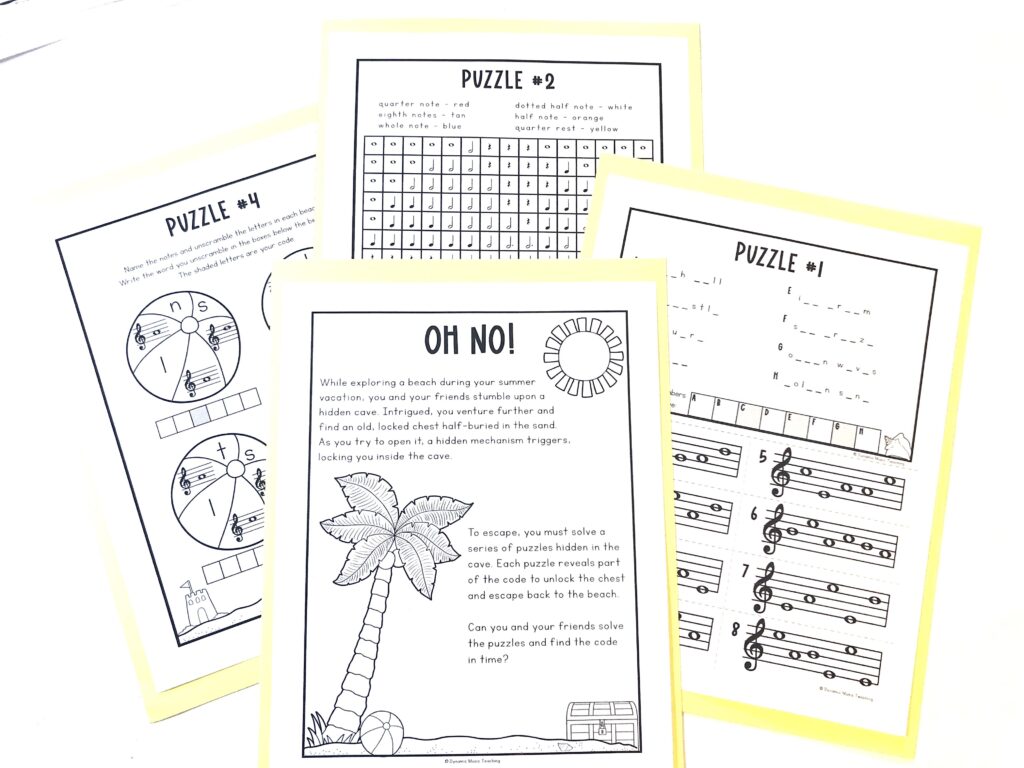
Escape rooms aren’t a quick game, but they are a student favorite, a great way to keep the music learning going on “fun days,” and a nice way to encourage teamwork.
Escape rooms are best, in my opinion, for grades 4 and up since some amount of logic and puzzle-solving skills are usually involved in addition to music skills. That’s what makes an escape room different than just a set of worksheets after all!
Music escape rooms can be used to review rhythms, note reading, symbols, dynamics, instruments, composers, and more. My escape rooms often include a variety of puzzle types like color-by-note activities, mazes, music math, decoding challenges, drawing notes on the staff, and more. Students solve multiple puzzles in order to unlock codes or decoders and continue through the game.
If you have the time and love to create, escape rooms are tons of fun to make for your students! Let your creativity go wild and create a story, music puzzles, codes, and more. If you really want to go all out, you can even use a programmable lock so students can unlock an actual lock to check their code. I don’t usually do this, but it adds a whole other level of fun.
I have lots of pre-made print-and-go escape rooms in my shop for grades 4 and up, including rhythm escape rooms, and holiday music escape rooms.
Trashketball
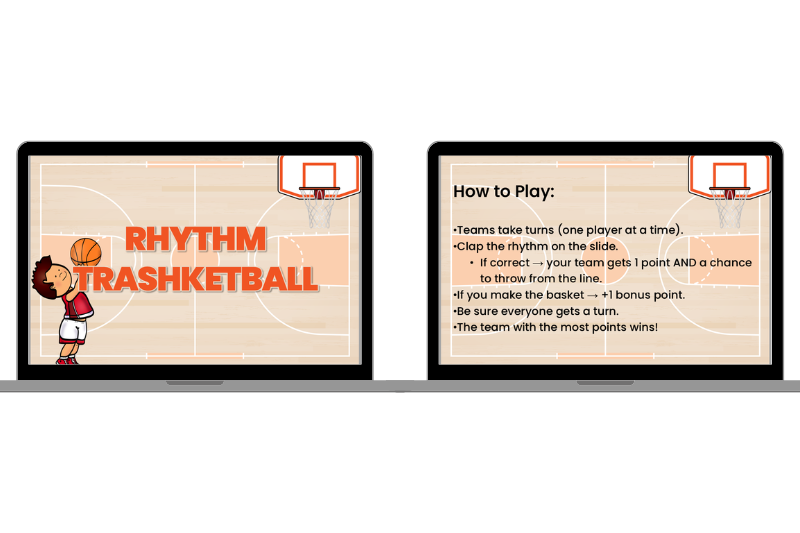
Trashketball is another game that can be used to review almost anything. At its most basic, students answer questions to earn a chance to toss a balled-up piece of paper into a trash can.
You could use this for note reading if you have note name flashcards, solfege, music symbols, and many other concepts. For music trashketball, my personal favorite is rhythm review, and I wrote an entire post about how to play rhythm trashketball here.
How to Play
You Will Need:
- A small ball or crumpled piece of paper
- A trash can or recycling bin
- A set of flashcards (rhythms, notes, symbols, solfege, etc.)
Instructions:
- Divide the class into 2 or more teams.
- Teams take turns one player at a time.
- On each turn, a player answers the question on the flashcard (for example, clapping the rhythm or naming the note).
- If the answer is correct, the team earns 1 point.
- The player then gets a chance to shoot the ball into the trash can from a designated throwing line.
- If the basket goes in, the team earns 1 extra point.
- Continue alternating turns until every student has had a turn or all cards have been used.
- The team with the most points at the end wins.
You can play music trashketball with any set of flashcards you already have, or if you’d like a ready-to-go leveled game for rhythm, you can find them in my shop here.
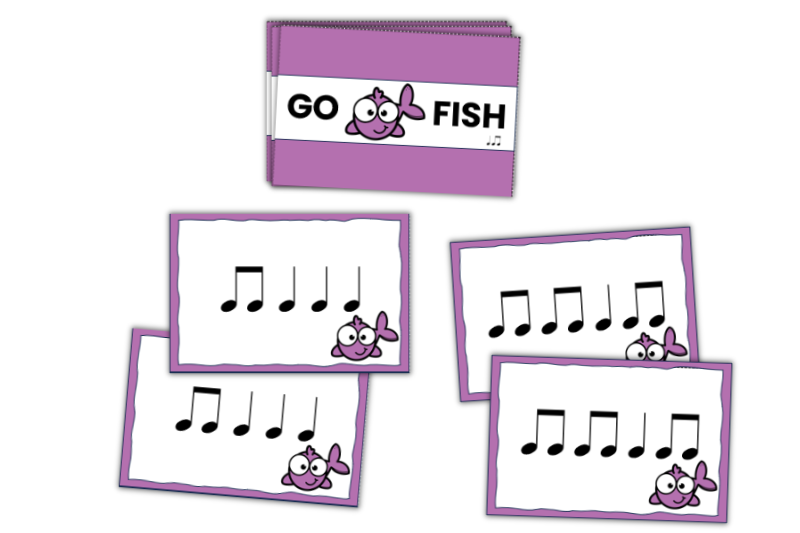
Go Fish
For early elementary grades, Go Fish is a very familiar game and can be used to practice note reading or rhythms.
You can read more about how to play rhythm Go Fish here.
How to Play
You Will Need:
- A deck of matching music flashcards
To create your own game, you will need several sets of matching cards. For example, you might have 4 matching Middle C cards, 4 matching B cards, and so on.
Instructions:
- Shuffle the cards and deal:
- 2–3 players: 7 cards each
- 4–6 players: 5 cards each
- Place the remaining cards face down in a pile.
- On a player’s turn, they ask another player for a matching card.
- For note reading: “Do you have Middle C?”
- For rhythm: students may say, tap, or clap the rhythm on the card.
- If the other player has the card, they must give it to them.
- If the player makes a match, they place the pair face up in front of themselves and take another turn.
- If the other player does not have the card, they say “Go Fish!” and the player draws from the pile.
- Play continues until all cards are matched.
Winning the Game:
The player with the most matches wins.
If you’d like a ready-to-use rhythm Go Fish game, you can find 8 levels in my shop here.

Music 4 Corners
Music Four Corners is a simple movement game that works well for rhythm review, note reading, instrument families, symbols, and more. It’s one of my favorite elementary music games because students get to move while reviewing concepts at the same time.
For rhythm review, students might listen to or clap rhythms and move to the matching corner. For instrument families, each corner could represent brass, woodwinds, percussion, or strings. You could also use the game for dynamics, note names, or even composer review.
How to Play
You Will Need:
- 4 signs or posters for the corners of the room
- A list of music questions, rhythms, notes, or concepts to review
Instructions:
- Label each corner of the room with a different answer choice or category.
- Explain the rules to your students.
- Present a music question, rhythm, or concept.
- Students move to the corner they think is correct.
- Reveal the answer and briefly review it with the class.
- Continue playing with new questions or rhythms.
Optional:
For a calmer version, assign students to a corner and have them stand up or sit down instead of moving around the room.
Read more about playing rhythm four corners in this post here.
You can easily create your own music Four Corners game for almost any concept, but if you’d like ready-to-play rhythm versions, you can find my rhythm bundle here.
Matching Games
Matching games are familiar and are a good way to review music concepts such as note names, rhythms, symbols, or instrument families in the early elementary grades.
They work well in centers or private lessons. If you would like students to record their work, you can also add a recording sheet for students to write down some of their matches.
A more game-like alternative is to play Memory.
How to Play
You Will Need:
- A set of matching cards
Instructions:
- Turn all cards upside down and mix them up.
- Students take turns turning over 2 cards.
- If the cards match, the player keeps the cards and takes another turn.
- If the cards do not match, they are turned back over and the next player takes a turn.
- Players should try to remember where cards are located to help them make future matches.
- The player with the most matches at the end wins.
For Older Grades:
If your students are too old to enjoy matching games, the cards can also be used as a partner activity. Give each student half of a matching pair and have them find the person with the matching card.
If you have an odd number of students, you can participate as well.
Jeopardy-Style Quiz Game
Jeopardy-style quiz games are another activity that can be used for almost anything. Each category can review a different concept. For example, one column could be note reading, another rhythms, another dynamics, and so on.
This is a fun game to play before breaks or at the end of the year to review everything students have learned.
These games can take a bit of time to make, but they are easy to tailor to exactly what your class has learned. If you are less tech-savvy, you can often find templates online and simply add your own questions.
How to Play
You Will Need:
- A Jeopardy-style game board
- Questions and answers
Instructions:
- Divide the class into teams.
- Display the game board with categories and point values.
- Choose a team to go first.
- The team chooses a category and point value.
- Read the clue or question aloud.
- Teams work together to decide on an answer.
- Decide whether only the current team may answer or whether other teams may “steal.”
- Award points for correct answers.
- Continue until all questions have been used or time runs out.
- The team with the most points wins.
Need Even More Elementary Music Games?